
Key points
- Shaker is the safe all-rounder and works in old and new houses alike.
- Slab and handleless doors suit modern rooms and small kitchens.
- The in-frame look is the most traditional and suits period homes.
- Colour and handles change the feel of a door as much as its shape.
- Look at samples in your own kitchen before you decide.
What is a shaker door?
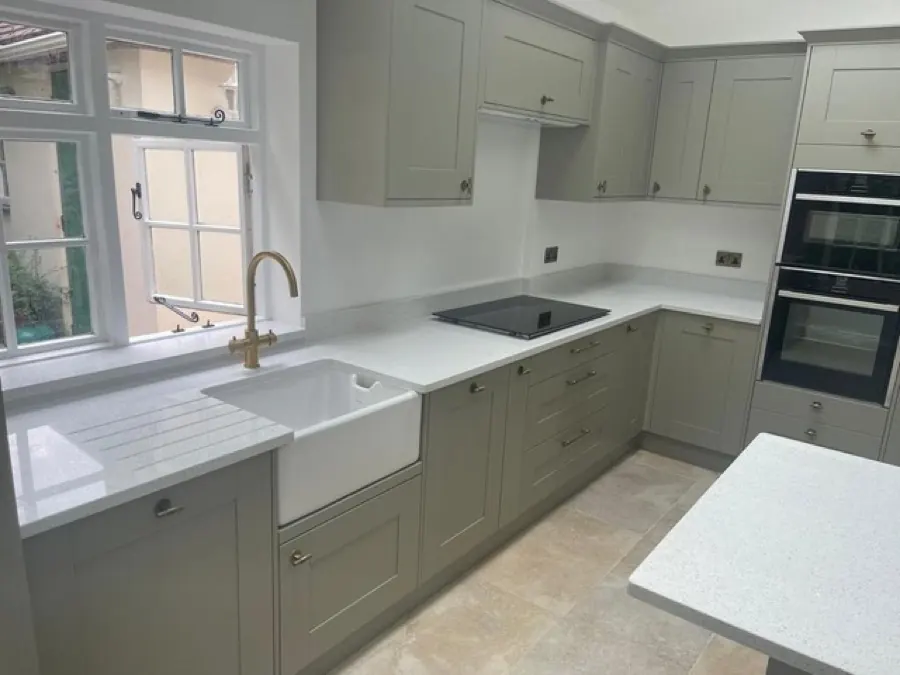
A shaker door is a flat panel with a raised square frame around it. It has been around for a very long time and has not dated, which is the main argument for it. In a pale colour with simple knobs it looks traditional. In a dark colour with long bar handles it looks modern.
If you do not know what you want, start with shaker. It is hard to get wrong.
What is a slab door?
A slab door is one flat face with no frame and no detail. The look is clean and plain. Slab doors are quick to wipe down, because there are no ledges for grease to settle on. They suit newer houses, flats and extensions, and they keep a small kitchen from looking fussy.
With a slab door, the finish does the talking. A matt painted slab and a woodgrain slab are very different kitchens.
What does handleless mean?
A handleless door has no handle fixed to the front. You open it by a grip shaped into the edge of the door, or by a recess behind it. The fronts line up as unbroken bands of colour.
It is a sleek look and nothing catches on your pockets. It also takes a bit more wiping along the grip. Whether it can be done on your existing cabinets depends on how they are built, so it is one to ask about at the visit.
What is the in-frame look?
In a true in-frame kitchen, each door sits inside a solid frame fixed to the front of the cabinet, like a door in a doorway. It is how kitchens were made by joiners, and it is the most traditional of the four. In-frame style doors give that same framed appearance and are one of the styles I fit to existing cabinets.
A related detail is the Georgian bar door: a glazed door divided by slim bars. One or two on a wall run break up a long line of solid doors.
Which style suits which house?
| Style | Look | Tends to suit |
|---|---|---|
| Shaker | Framed panel, simple and balanced | Almost anything: terraces, semis, bungalows, new builds |
| Slab | Flat and plain | Modern houses, flats, extensions, small kitchens |
| Handleless | Flat with no visible handles | Open-plan rooms and contemporary homes |
| In-frame look | Door set within a surround | Cottages, farmhouses and period properties |
These are leanings, not rules. A shaker door in a modern colour can sit very well in a new build, and a plain slab can calm down a busy cottage kitchen.
How much difference do colour and handles make?
A great deal. Doors come in painted and woodgrain finishes, from classic white through to deep navy and sage. The same shaker door reads completely differently in each. Handles do the same job on a smaller scale. Brass warms a dark door. Black sharpens a pale one. Chrome and nickel sit quietly on most colours.
Think about what is staying, too. If you are keeping the floor or the wall tiles, the door colour has to live with them. If the worktops are changing as well, choose the two together. Kitchen worktop options covers that side.
Can you change style without changing the kitchen?
Yes. That is the point of replacement kitchen doors. The new doors are made to measure for your cabinets and do not need to copy the old ones. Whether doors alone will be enough is covered in can you just replace kitchen doors.
How should you choose?
Not from a screen. Colours shift with the light, and a door that looks grey online can look green at home. I bring door samples to your kitchen so you can hold them against your own walls and floor. Book a free home visit if you are in Worcester, Church Stretton, Tewkesbury or anywhere else I cover.